News & updates

Field reports, milestones and partnership announcements.

Real reporting and conference proceedings featuring IVEPCR / ISTH.

Surveillance Bulletin
IVEPCR Surveillance Unit, ISTH

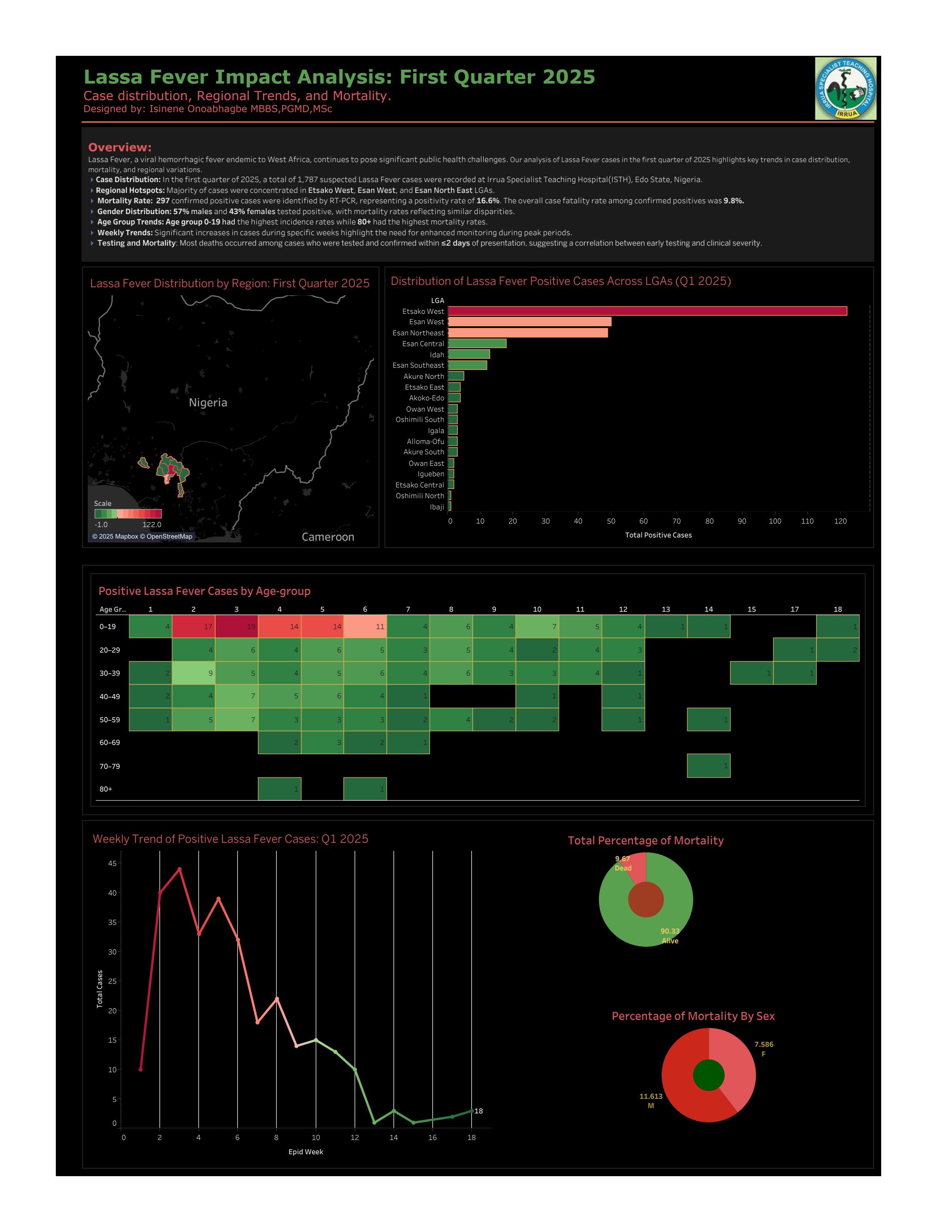
Lassa Fever Impact Analysis: First Quarter 2025.

1,787 suspected Lassa fever cases were recorded at ISTH in Q1 2025, with 297 RT-PCR confirmed positives (16.6% positivity) and a 9.8% case fatality rate. Etsako West, Esan West and Esan North East emerged as the leading hotspot LGAs; the 0–19 age group carried the highest incidence while the 80+ group had the highest mortality. Designed by Dr. Isinene Onoabhagbe.

View surveillance dashboardLassa Fever Q1 2025 surveillance poster — case distribution, regional trends and mortality at ISTH
Download PDF →
Conference Abstracts
West African Health Organization (WAHO)

38 ISTH / IVEPCR abstracts accepted at the WAHO 2nd Lassa Fever Conference, Abidjan 2025.

ISTH and IVEPCR researchers had 38 abstracts accepted across all five conference pillars — spanning regional coordination, clinical research and medical countermeasures, surveillance and outbreak response, community engagement, and governance & sustainable financing for epidemic preparedness.

View all 38 accepted abstracts

Pillar 1 — Regional Coordination and Cross-Border Preparedness

  1. The Institute of Lassa Fever Research and Control: An Indigenous Interventional Initiative in Lassa Fever Control

Pillar 2 — Advancing Research and Medical Countermeasures for Lassa Fever and other VHFs

  1. Post-Mortem Pathological Insights into Lassa Fever via Minimally Invasive Tissue Sampling: A Comparative Study in a West African Endemic Region
  2. Predictive value of the Modified Early Warning Score for mortality and ICU admission in Lassa fever patients: a retrospective analysis
  3. Divergent Pathways of Severe Lassa Fever: Vascular leak and Hyperinflammation versus Neurological Disease — Recommendations from the PATHOGENESIS Study
  4. Early Dialysis and Innovations for a better Outcome in Lassa Fever Patients with Acute Kidney Injury
  5. Safety and tolerability of favipiravir compared to ribavirin for the treatment of Lassa fever: A randomized controlled open-label phase II clinical trial
  6. Lassa Virus Strains sequenced during the 2009–2012 Lassa Fever Epidemics, Setbacks and Prospects of Disease Burden — An Epoch
  7. Patterns of Modified Early Warning Scores in Hospitalized Lassa Fever Patients: Insights from ISTH
  8. Evaluation of serum albumin as a prognostic marker in Lassa fever disease
  9. Evaluation of four Lassa Virus IgM Immunoassays for early detection and seroprevalence studies in West Africa
  10. Comparative Evaluation of five Lassa Virus IgG Immunoassays for seroprevalence studies and vaccine trial support in West Africa

Pillar 3 — Surveillance, Early Detection, and Rapid Response

  1. Strengthening outbreak response in West Africa: Insights from a Nigerian simulation exercise
  2. Improving Infection Prevention and Control during a Lassa fever outbreak: Experience from a Military Hospital in Nigeria
  3. Lessons learnt from the 2023 Lassa Fever Outbreak in an Endemic Nigerian State: A WHO-guided After Action Review Process
  4. Clinical and Paraclinical Correlates of Severe Lassa Fever: First Results of the Irrua Lassa Fever SEPSIS Study
  5. Lassa fever in multiple gestation: Two cases with positive umbilical cord blood Lassa PCR in the absence of maternal viremia
  6. Impact of haemodialysis on the outcome of severe paediatric Lassa virus disease — Question of a half loaf?
  7. Case Report: prolonged proteinuria in a young healthy male treated for Lassa fever complicated by Acute Kidney Injury
  8. Contribution of Lassa Fever to Severe Acute Kidney Injury in An Endemic Area: A Retrospective Observational Study in Southern Nigeria
  9. Lassa Fever in Pregnancy: Outcomes and Management Approaches at ISTH
  10. Impact of Optimized Haemodialysis on the Outcome of Acute Kidney Injury in Lassa Fever: A study at ISTH, Nigeria
  11. Implementation of a nanopore genomic surveillance unit for emerging viral pathogens at ISTH, Nigeria
  12. Indications and potential diagnostic utility of lumbar puncture in the management of non-neonatal paediatric Lassa virus disease
  13. Disease severity and outcome of Lassa virus disease among Nigerian children with Sickle Cell Anaemia: an observational study
  14. Health literacy and preparedness for outbreak of Marburg Virus Disease among doctors and nurses at a reference VHF treatment centre in Nigeria
  15. Presentation and outcome of Neonatal Lassa Virus Disease in endemic areas of Nigeria: A report from ISTH
  16. A place for lumbar puncture in the standard of care of neonates with suspected sepsis in Lassa Virus Disease in endemic areas: The ISTH experience
  17. Insights into long-term antibody response in Lassa fever: A five-year follow-up study of survivors in Nigeria
  18. Persistence and Infectivity of Lassa Virus in Body Fluids: Implications for Survivor follow-up and Public Health
  19. Hemorrhagic pericardial effusion in Lassa virus disease in children: A report of three cases

Pillar 4 — Community Engagement and Social Science Approaches

  1. Lessons learnt from Community Engagement in a Prospective Cohort Study on Lassa Fever Incidence in Edo State, Nigeria
  2. Perception and Determinants of Acceptance of a Future Lassa Fever Vaccine in Endemic Communities of Edo State, Nigeria: A Cross-Sectional Study
  3. A Qualitative study of Frontline Perspectives and Experiences of Field Workers in the CEPI ENABLE 1.0 Lassa fever Epidemiological Cohort Study in Edo State, Nigeria
  4. Assessment of vaccine acceptance and perceptions of Lassa fever among acutely ill patients in Edo State, Nigeria: Findings from a cross-sectional study
  5. Sociodemographic Characteristics and Prevalence of Psychological Distress among Caregivers of Lassa Fever Patients at ISTH, Edo State, Nigeria

Pillar 5 — Policy, Governance, and Sustainable Financing for Epidemic Preparedness

  1. A Governance Model for Lassa Fever and Emerging Infectious Diseases: The Irrua Institute Initiative
  2. Impact of Emergency Operation Centre Meetings on Lassa Fever Case Management in Edo State, Nigeria 2025
Read source →
ECOWAS Conference
West African Health Organization (WAHO)

2nd ECOWAS Lassa Fever International Conference convenes in Côte d'Ivoire.

Under the theme 'Beyond Borders: Strengthening Regional Cooperation to Combat Lassa Fever and Emerging Infectious Diseases', LIC 2025 brought together global experts, ECOWAS health ministers and frontline institutions including IVEPCR — building on the momentum of the inaugural Abuja 2019 conference.

Read source →
Governance
AFENET Journal

IVEPCR governance model showcased at AFENET / ECOWAS LIC 2025.

Asogun, Okoeguale, Eifediyi and colleagues presented the Irrua Institute Initiative — a governance model for Lassa fever and emerging infectious diseases — at the ECOWAS Lassa Fever International Conference scientific track.

Read source →
Outbreak Response
AFENET Journal

Edo State Emergency Operation Centre meetings improve Lassa case management.

A study co-authored by IVEPCR / ISTH faculty (Edeawe, Tobin, Otaigbe, Okoeguale, Eifediyi) documented the impact of EOC coordination meetings on Lassa fever case management in Edo State during the 2025 outbreak.

Read source →
Indigenous Initiative
AFENET Journal

Indigenous Lassa fever initiative profiled at AFENET ELIC 2025.

Asogun, Okoeguale, Eifediyi, Guenther and Tobin presented the history of the Institute of Lassa Fever Research and Control — the indigenous initiative that became today's IVEPCR.

Read source →
Outbreak Response
Daily Trust

Lassa fever claims 70 lives across Nigeria in opening weeks of 2025.

NCDC reported 1,552 suspected cases, 358 confirmed cases and 70 deaths from Lassa fever since the start of the year, with Edo, Ondo and Taraba most affected — placing IVEPCR's reference laboratory at the centre of the national response.

Read source →
Field Operations
World Health Organization

WHO feature: on the frontlines of the fight against Lassa fever in Nigeria.

WHO profiled the work of clinicians and laboratory staff in Edo State, including the Lassa isolation ward at Irrua, where rapid diagnosis and ribavirin treatment continue to save lives.

Read source →
State Response
Idoma Voice

Edo State declares fresh Lassa fever outbreak.

The Edo State Commissioner for Health, Dr. Cyril Oshiomhole, confirmed cases and called on residents to improve hygiene and report suspected cases — with referrals routed to the IVEPCR / ISTH treatment centre in Irrua.

Read source →
Official reports

Downloadable IVEPCR sequencing reports.

Official sequencing and bioinformatics reports issued by the IVEPCR Department of Sequencing and Computational Biology at ISTH.

Annual Progress Report
2024

Progress Report in Sequencing and Bioinformatic Analysis (2024)

Comprehensive 2024 progress report from IVEPCR's Department of Sequencing and Computational Biology — covering Lassa virus and SARS-CoV-2 sequencing milestones, training activities, partnerships and Official Reports N°01–N°06.

Official Report N°07
23 June 2025

Official Report N°07 — 2024 Lassa Outbreak Sequencing & Phylogenetic Analysis

Metagenomics sequencing results from the 2024 Lassa fever outbreak: 18 of 26 LASV-positive samples yielded genomes for phylogenetic analysis, all clustering within lineage II with evidence of independent transmission events.

Stay informed

Outbreak bulletins, research updates and conference news — straight to your inbox.

IVEPCR
IVEPCR

Institute of Viral and Emergent Pathogens Control and Research — a national reference centre for emerging infectious diseases at Irrua Specialist Teaching Hospital, Edo State, Nigeria.

Established 2007 · Formerly Institute of Lassa Fever Research and Control

Contact
© 2026 IVEPCR. All rights reserved.National reference centre for emerging infectious diseasesBuilt & designed by Isinene Onoabhagbe